
Mickey Raphael: Sideman Superman
The Timeless Wisdom of Less

“Knowledge speaks, Wisdom listens” -Jimi Hendrix
Harmonica is loud. It can be annoying, ear-splitting, deafening, and destructive. It’s a tiny sonic bomb in the wrong hands. It can be used as a weapon of mass musical destruction or as a unique, beautiful texture over many styles of music. The job description of the harmonica player in any band is not just being a good musician, but to proceed with a healthy degree of caution, knowing full well that the instrument in his or her hands can be used for good or evil.
The fate of the band is in your hands, and they are relying on you to not just show up and blow your reeds out, but to add to the collective musical experience.
In other words, with great power comes great responsibility.
Much of the life of a harmonica player is spent with a devil/angel combo on their shoulders. On the one hand, it would be super fun to throw all caution to the wind and rip as many chops as possible, totally blowing out the other band members and ensuring the audience leaves before the third song. On the other hand, the discipline and patience in holding back, in coloring the music sympathetically, in putting the harmonica right in the melodic sweet spot, not just to enrich the composition but also to avoid drawing too much attention to the player themselves.
Harmonica can wear many hats. Yes, it is first and foremost a solo instrument, but it can also comp, play partial chords, and provide rhythmic support. With so many choices of what to do to add to the music, the harmonica player has to exercise a good amount of self-control and musical judgment to see what best fits the song. This takes years to master. Wisdom in a harmonica player does not come from chops: it comes from achieving a delicate balance between technical ability and sensitivity to the other musicians on stage.
There have been many great harmonica players throughout time.
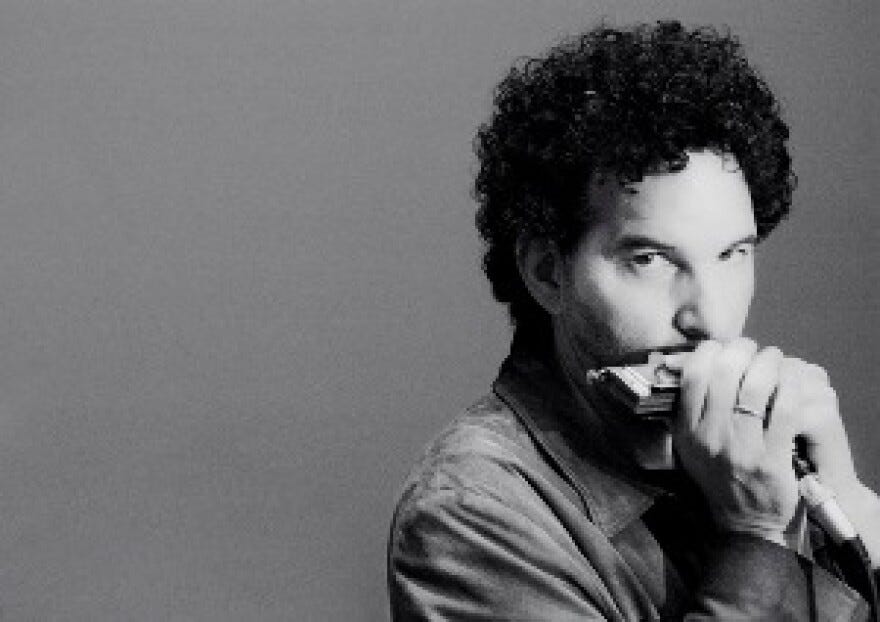
I’ve never seen one more sympathetic or more aware than Mickey Raphael.
Best known for his 40+ years with Willie Nelson, I first heard his name when I got into studying country music around age 20. I had been playing for a few years and was getting tired of the blues. I wanted to expand my musical vocabulary and playing. Logically, country made sense for a harmonica player. I began listening to all the great country players (Donnie Brooks, Charlie McCoy, Todd Parrot, Terry McMillan) and was delighted to discover how different their styles were from the blues I had been hearing all my life. I began to incorporate more major pentatonic stylings into my phrases; I also focused more on accompaniment (playing behind a vocalist), which completely changed how I conducted myself as a musician.
It took learning country harmonica to understand one of the most elemental aspects of music: It’s not about you. It’s about the song. That lesson was not just necessary to learn but also changed how I approached my music entirely.
As I explored more players, I finally happened upon a video of Mickey playing behind Willie Nelson on the song “Georgia on My Mind.”
What astounded me about this song was not how little Mickey played, but how much of a presence the harmonica had despite the sparseness. Dynamics, tone, and especially musical knowledge were all on display on a level I hadn’t visually seen up till that point in my life. In his solo, he let loose, showing just how much restraint he was utilizing during the verses and choruses.
Restraint, especially as you become a better harmonica player, is one of the most underrated skills you can learn. With a world of techniques and phrases at your fingertips, much of being a good harmonica player comes down to holding back, to practicing good dynamics, and effective phrasing.
Mickey’s style of harmonica playing is sparse but beautiful. It’s also much harder than it looks. In the same way that many of the greatest prose stylists like Hemingway, Carver, or Didion say so much with so little words, Mickey’s playing reminds me always of the power of simple, effective melodies played sincerely and with confidence, not cockiness.
When studying and trying to incorporate some of Mickey’s style into your own playing, here is what I would recommend as practical, take-home advice:
Begin playing harmonica in the background of your favorite songs that don’t currently have harmonica in them. Listen for the blank spaces where the singer isn’t singing. Try to fill in the spots as tastefully as you can, using techniques like vibrato, hand wahs, and double stops.
Engrain the Major Pentatonic Scale in your vocabulary. I know many harmonica players don’t want to hear the word “scale” or “theory”, but this particular one is endlessly helpful in ALL styles of music. If you need to familiarize yourself with it, my buddy Jason Ricci has a great lesson on it here.
Play alongside more singer songwriters. As much as I love playing at blues jams, getting into a partnership with a good singer is a wonderful, underrated way to improve your ability as an accompaniment player. In addition, always be asking questions of the people you work with, making sure that what you are playing on the harmonica is on the right track/ fulfilling their vision for their songs.
As a general rule of thumb, don’t play in the first verse. Yes I know, there are some songs that need it, but on the whole it’s a good idea to lay out at the beginning and come on stronger at the end.
Pay close attention to the vocalist and what the song is about. What are the lyrics? Is the song happy, sad, undecided, annoyed, depressed? These adjectives and interpretation of the words allows you make better choices about how to musically tend to the feel of a song.
Listen to this clip of Mickey playing accompaniment to Chris Stapleton on Angel Flying Too Close To The Ground. Sparse, beautiful, and tasty as hell.
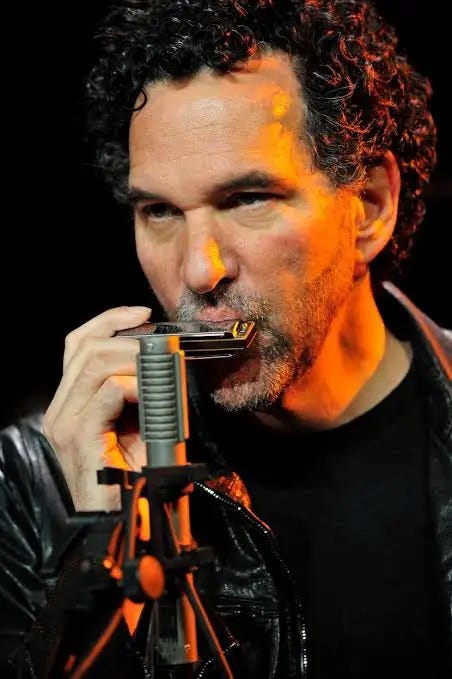
He makes every note count, utilizing the strengths of the harmonica in his solo. His vibrato and hand technique is used to great effect in a way that does not take away from Chris’s vocals, and give him space to tell the story of the lyrics. There’s no wasted breath. Also, on a technical note, look at how far back Mickey is from the microphone, allowing him to use his hands more expressively.
All great harmonica players have some valuable lesson for us. Every canonical player I’ve studied has given me endless ideas and a sense of wonder. With Mickey, he is a consistent reminder of the power of simple phrasing, active listening, tone, and musical compassion.
Many young harmonica players nowadays want to be filled to the brim with technical ability to wow social media audiences. However, without proper restraint and the discipline you learn from someone like Mickey Raphael, its knowledge for the sake of knowledge, clout for the sake of clout.
Music is not just about the acquisition of money, fame, or technical virtuosity. Music, in many ways, is just another arena of life where all we desire as human beings is to be seen, and most especially heard. Listening, reacting, responding and appreciating.
Mickey’s wisdom is not just in his tone or phrasing; it’s in his ability to make the other musicians comfortable on stage, to make them feel heard, to make the whole unit move forward.
As a musician on the bandstand, no matter what you play, our highest honor is being a team player. In his years with Willie Nelson and his more recent work with Chris Stapleton, I see Mickey as the ultimate team player. His work speaks for itself.
Mickey continues to be a huge inspiration to me to this day. He’s humble, good natured, and a consummate musician. As a young harmonica player, I look to him for guidance and a model of harmonica professionalism on the big stage.
-Shane
Loved the post and love Mickey's style of play. I try to keep it low key. Sometimes I get so much into the song I commit the sin of overplaying. It seems to be a delicate balance. Great Post!
Mickey Raphael is THE reason I started playing harmonica many years ago. He is an absolute inspiration to me, and I've told many people about him after they've heard me play. I play with two young singer-songwriters and, after one show, a member of the audience actually came up to me and said "you play like Mickey Rafael"...I was blown away by this! It is, by far, the biggest compliment of my relatively short performing career. A great post, Shane!