
Creative Rituals
The Beauty of the Everyday Tedious

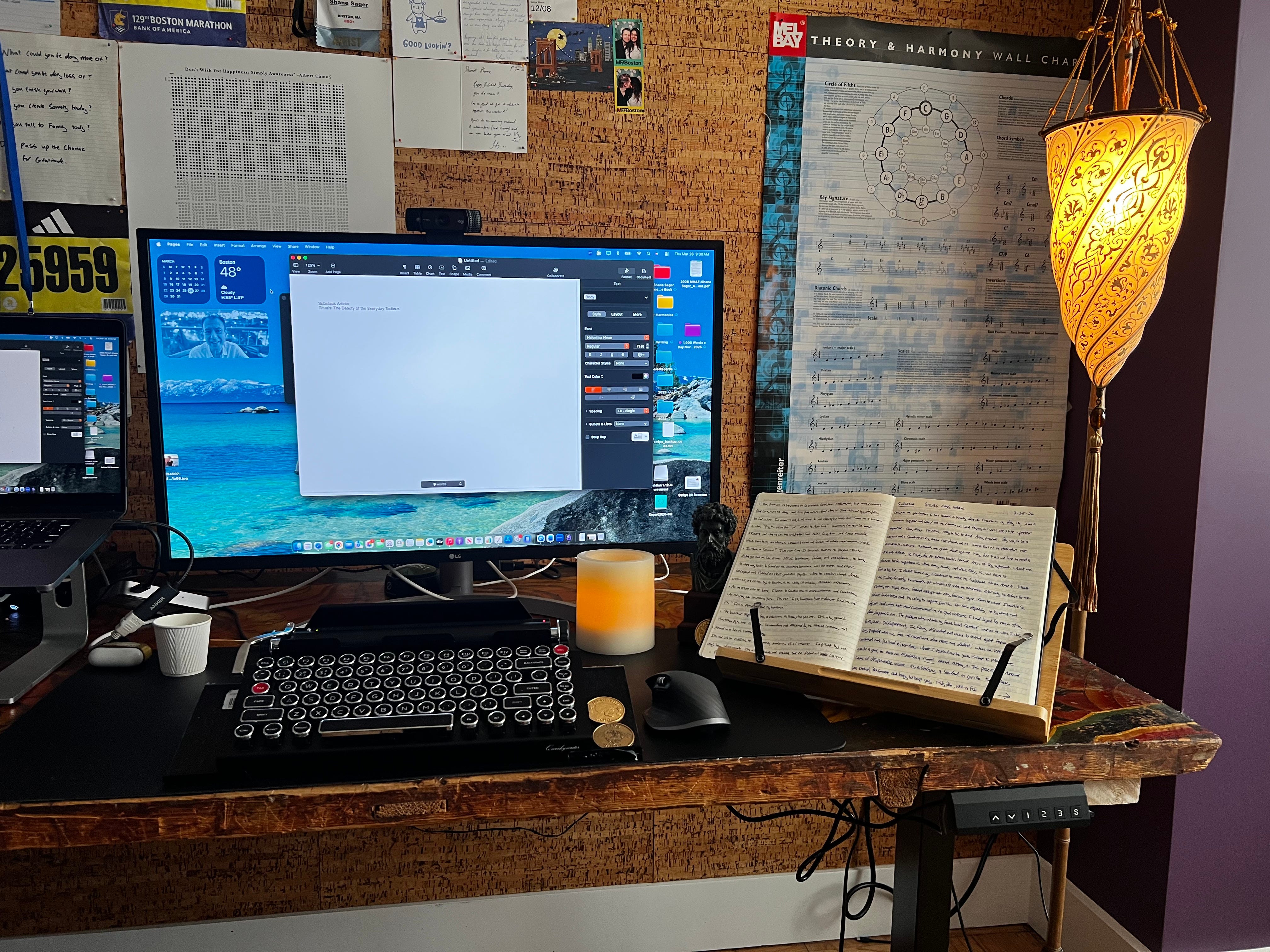
"Be regular and orderly in your life, so that you may be violent and original in your work.” -Gustave Flaubert
Despite my tendency toward a hearty dose of chaos in my daily life, I believe the rituals we have, regardless of our work, are of the utmost importance. Early mornings. Making time to read. Tracking output. Spiritual practices. Asking questions. Openness to avenues that draw us in. Being willing to embrace a student mentality in all that we do and never expecting to exhaust or end our ongoing education to become better artists and more grounded people. I’m a fan of dedication, not outcomes.
Outcomes are great, don’t get me wrong, but if all we have in mind is results, the everyday joy of tedious tasks loses the hard-to-find splendor of being important. What we deem important is where energy flows. Where energy resides, so does our focus.
We only have so much we can allocate to areas of our busy lives. Rituals give us a sense of everyday sameness without dulling the colorful unpredictability of the external world. If anything, they allow us more freedom to grow into the people we have the potential to become.
For a long time, I didn’t know why I kept writing this Substack. No one read it. The eyes, likes, and subscribers I craved weren’t coming to me. It felt like I was shooting thousands of words out into the electronic ether only to return to me, reminding my fragile ego of many failed attempts to say something that might actually matter. It was depressing. Long months of hard work that never culminated in the grand outcome I had hinged my daily happiness on. Right there was my problem. I put my happiness on something that was never going to pay me back daily. Happiness is nothing more than an emotional response to an outcome. Without outcomes, I was lost in a haze of daily doldrums. Happiness eluded me the more I believed it would find me every day. It’s just not reality.
I’ve found over the years that disappointment is only palpable when we feel we could have done more and chose not to; when we left stones unturned and pulled the plug early. When dealing with daily struggles, disappointment becomes much easier to access when in pursuit of some imaginary happiness far off in the future. However, there is an antidote.
I remained result-oriented until one day I realized that the joy of writing was enough to carry me through the hard times; watching the viewership drop and fall began to matter less to me than the pure ritual of sitting down to write every day. It wasn’t happiness I was cultivating, but joy. Joy is self-sustaining, merely enjoyment brought about in the “doing” of what it is we love to do. Joy doesn’t need an outcome, but it does require ritual. It requires hard work, ramifications, gravity, and a sense of duty.
While a goal is important, I’ve found that the more we want to get somewhere, the more joy we find in our work. The more we give, the more important the ritualization of the process becomes. The prize is not fame or disposable income: it’s establishing a daily standard in your life that makes you excited, passionate, and hungry to keep going. Fishing pole, not a fish.
A ritual is a reminder to yourself that, no matter what art form or goal you’ve chosen, this is not only important to you but essential to who you are. If you are a fit person or an athlete, your workouts are not something you have to do; they are something you must do, as they comprise a part of your identity. It’s not a chore if it’s who you are.
In the creative process, ritual is not easy to start, but once you get going, it is very, very difficult to break. Rituals are an invitation to greater structure, not a binding, inflexible code. They change, adapt, and evolve just like you do. They are meant to keep you on the straight and narrow instead of fumbling through your day with loads of guesswork.
What are some ways to implement a ritual habit into your creative practice?
Choose time slots. Aim for 4-5 slots per week to make time to work on your craft. Try to keep them the same every week. As you adopt a Pavlovian effect, the more similar the practice times are, the more effective it becomes. Habits are best developed when you take choices out of the equation. Keeping your slots the same time simplifies life. Personally, if I miss a day of practice now, I don’t feel right. That’s from years of drilling this. It must become behavior, not a lightning strike.
Pre practice, set your intention. How many of you have sat down to your practice session and had no idea what to play? That’s largely because you didn’t set your intention; you didn’t have a plan for the practice. The more focus and ritual you put behind having an outline and work in progress, the more you’ll get out of it.
Pair your creative act with something you already do every day. For me, this is having a cup of coffee while I’m writing or playing harmonica. I can only have this drink if I’m doing one of these two activities. It’s my reward for showing up. Many of you out there probably already have a coffee ritual; why not pair it with something you want to get better at? Caffeine helps.
While a practice journal isn’t everyone’s favorite, I strongly believe in it. I think writing down what you’re working on adds a great deal of ritual to the practice, as well as keeping track of your progress. In almost every area of life that involves an outcome, tracking progress is crucial; the metrics are just different. With creativity, journaling allows you to not only track artistic progress but also emotional and spiritual growth.
Many people believe that rituals or more scheduling are not realistic; that the world changes too much, too fast; that they just don’t have time; that if they bring too much structure into their practice, they won’t have as much fun, or they’ll corporatize the whole process. In those same minds, it kills the flowery, unrealistic romance of “the creative”.
In reality, almost every famous or influential musician, writer, poet, painter, photographer, or designer followed some form of artistic ritual.
Artists and creatives tend to lead chaotic, colorful lives.
Great artists lead quiet, consistent lives of dedication to craft.
Rituals allow a framework and a sense of control in our inner lives. We have no control over the external world. We are only responsible for performing our craft with as much care, love, and attention as we can, as often as we can.
Matthew McConaughey said:
“There’s a responsibility in freedom, in that there is freedom in responsibility.”
We are all writing our own stories. Stories need structure, no matter how unique you believe yourself to be. In the chaos of my life, I have leaned heavily on the discipline and structure of rituals to keep me on track. They allowed me to discover and continue to discover my potential as a harmonica player. Harmonica allowed me to establish a template for responsibility, which I took into all other areas of creativity: writing, boxing, reading, and becoming a teacher. While we try to control the standards we have for our lives, we are only entitled to the daily, dubious tasks of getting incrementally better at the things we deem to be essential, creative pursuits. This never-ending process allows us to feel both a sense of purpose and a sense of progress, two things that keep our souls afloat as human beings.
We always need something to move toward. The more ingrained and engaged we are with our rituals, the more daily progress we will make toward the people we have the potential to become. A ritual is a right of passage to greater creative output, peace of mind, and the ultimate investment in yourself. What’s yours?
-Shane
Thank you Shane! Harpe Diem!