
Behind Beacons
A Fascination with Graves Lighthouse

“What is to give light must endure burning” -Viktor Frankl
Driving to the lighthouse is a multi-step process. Arrive at Rose Wharf. Boats bob up and down in the chilly Atlantic waters of Boston Harbor. Men with dry skin, wool sweaters, and thick beards help my dad and me with our bags as we load into a US Coast Guard boat.
It looks like something ready to take out Somali pirates. Machine guns were removed from the front of the vessel so as not to confuse or cause panic to the captains coming in and out of the port. Slowly, we reverse out of our humble docking. The seas are calm and coy in the late morning sun. As soon as we make the turn out of Rose Wharf, the wind picks up, and the water is much more active with fits of laughter and giggles as we increase our speed. The Sagers get seasick. It’s in our blood. I turn to my dad, both of us acknowledging the need for tenacity, stoicism, and hefty doses of Dramamine.
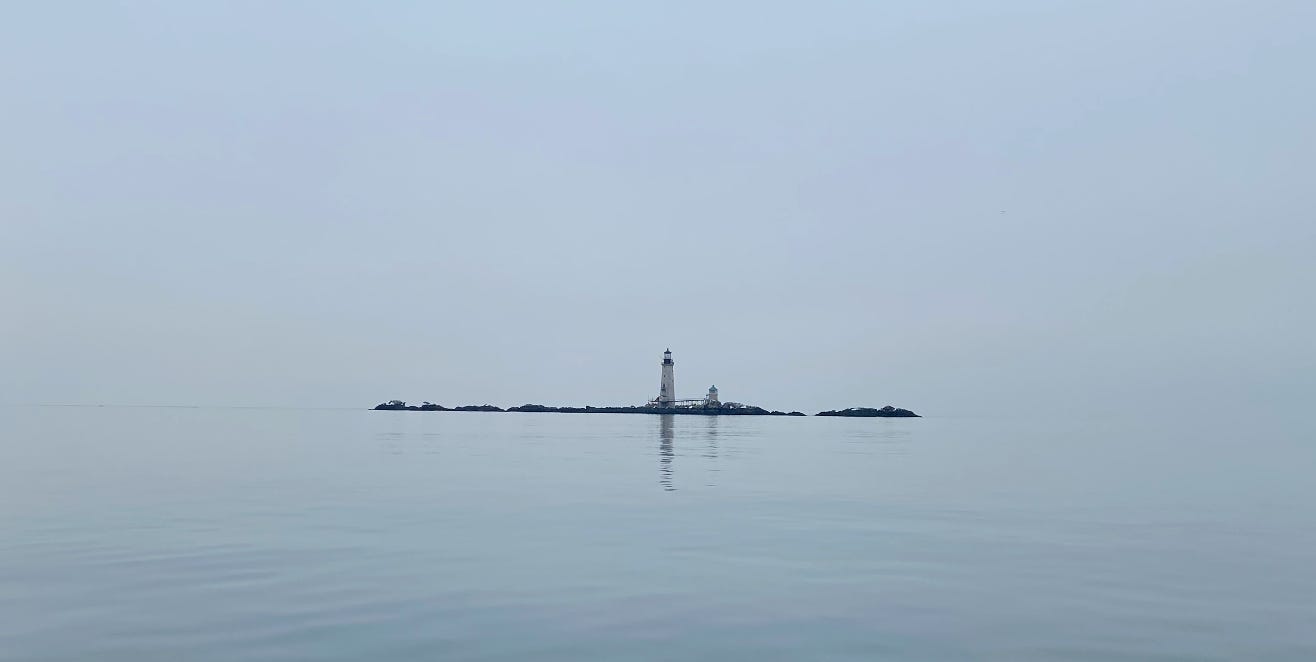
Our trusty vessel spurns forward, carving the ocean in half as we jet off into the mist. It takes about 30 minutes before we see it —a small flash of light ahead. In the shimmer of the fog, we begin to see the outline of the structure, tall and unmoved.
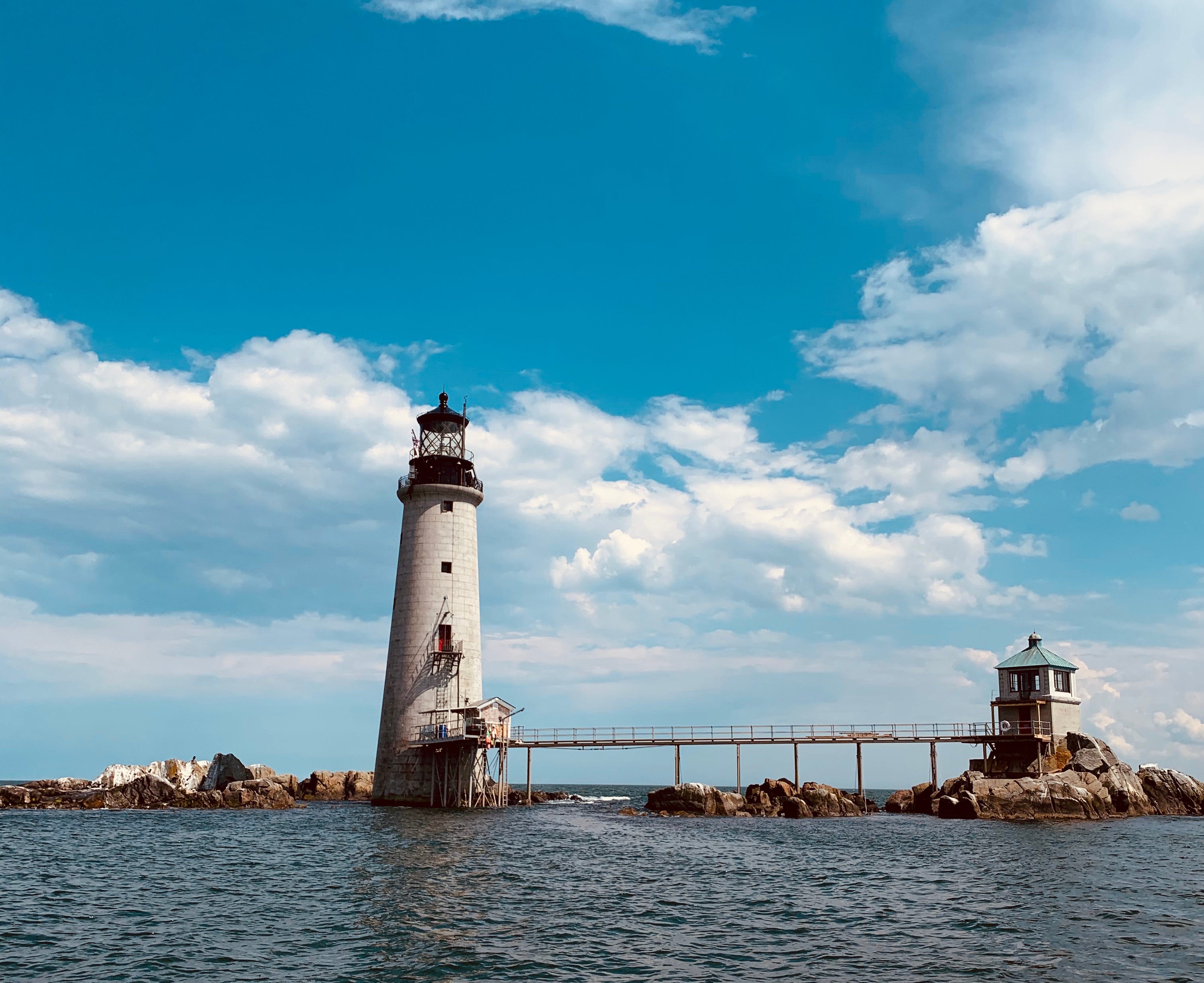
All around, rocks play host to hundreds of hungry seagulls, the once-pristine black of the geological mass covered with white smears of bird shit. Lazy seals lie on rocks, tummies down, and eyes fearful of approaching tourists. We are all just visitors here. The faded gray of the stone structure is dotted with water stains in the mortar cracks. A long, unsteady ladder grips the outside, and my dad and I look on in wonder and fear. Where are we?
Step two of the journey is more complicated. There is a cranking sound of metal as we lower our skiff into the angry waters of the Atlantic. Our Coast Guard boat, as strong as she is, is too big to bring us closer to the lighthouse, so we must resort to her annoying, less impressive little brother. We load our bags in, hop on either side to keep it from tipping, and begin rowing into the shallow waters. Mini waves lap at the sides, spraying us with droplets of salty water; a baptism of acceptance into the ecosystem of Graves.
From the skiff, we must now engage in the most dangerous task of all: standing atop a shaky plastic lifeboat and swinging ourselves onto a slippery ladder dangling over nothing but the freezing water, and climbing up to the dock. No big deal, right?
I remember the way the storm sounded that night. Waking up, my bunk was covered in cold, salty water, brushing against my face while I coughed with early morning phlegm.
My eyes gazed out at the alien world around me: endless streams of white-capped waves, abounding and smashing on invisible rocks, the caw of wild birds against howling winds, and scared seagulls dodging everywhere. The wind roared, whipping the worn wood of the window covers back and forth, slamming them against the damp stone of the structure.
There were no voices, no alarms; only the heavy breathing of my dad in the next bunk as he slept on in blissful ignorance. I made my way to the kitchen, ascending the steep stairs. Time for some coffee, made by straining hot water over coarse beans and hoping the electricity doesn't go out.
When you live in a lighthouse, everything is up and down; a vertical existence. There are no shortcuts. Privacy is temporary. Walking through rooms is a neccessary part of adapting to the ecosystem of this home in the sea. Each floor serves a specific purpose: the control room and power on the bottom floor, living quarters on the next two floors, a bathroom, a living room, a kitchen, and, finally, the light itself—a Promethean beacon of generous aura lighting up the darkness and despair of the unforgiving Atlantic.
Two days later, our food is running low. My dad and I have subsisted on half a peanut butter and jelly sandwich for breakfast and a smattering of chips, popcorn, and whiskey for dinner. Calorie count is low, morale is higher, and the experience of the storm causes us to care less about our diminishing state of nourishment.
It’s a sublime, psychedelic, and scary experience out here. Watching a storm from the comfort of a warm home in the city is one thing. Rain sounds different indoors. At the lighthouse, you are, in a historical and philosophical sense, the last line of defense against it; a last hope for weary sailors lost and far from home.
I always think about what must have gone through the heads of the men who served here for months at a time. We’ve only been here for a few days, and already it feels like we have existed a lifetime. I imagine the men, scurvy-ridden with sea-induced neglect. I imagine what they must have talked about, what went on inside the damp, dreary inner worlds of their weary souls.
We tend to over romanticize the beauty and reality of lighthouses in our culture today. Similar to many enigmas about the sea, we build up the wonder around the unknowns because they make us feel small by comparison. Humans have always felt a need to be a part of something; what’s bigger than the unknowns of our big blue marble and her hallowed waters? What is foreign and distant is made approachable and accepted the longer I spend in this structure.
I’ve always had a fascination with these stone sentinels of the sea. As a kid in history class, I remember being in awe of the Lighthouse of Alexandria, the great light shining forth from the birthplace of Western thought and discovery. The symbolism got me very early on. As I’ve gotten older, what I’ve realized is that a lighthouse, at its core, is not just a metaphor for the vicissitudes of life.
It reminds me that the duty of each and every human being is to choose their light; to act in a way that may guide others toward their goals. It is not just acting in a way that is good, but in a way that is true to who you are.
The ocean is a collective madness. In the dancing of waves, the smash of water upon rock, we hear a soundtrack older than time and truer than feeling; impenetrable to the intellect and cast away into the realm of violent searching. Crushing, crude, untamed, and righteous. Crashing waves envelop even the mightiest vessel in fear, man forever locked in a desperate battle with winds above and fearing giants diving and swimming in the deep. What is unknown is both meditative and maddening, intoxicating and terrifying.
The sea’s only gifts are harsh, direct blows of nature’s cosmic power. Questions build in the minds of the men who fight it, who sail and search in the desolation of watery worlds beyond the creased paper of worn-out maps. We will never know the depth, scope, and mystery of the murky, salty water.
We are merely specks of dust compared to the immensity of the deep; flesh-and-blood ticking time bombs insisting on our greatness in the face of overwhelming, elemental, and eternal awe.
Unfortunately for our fragile egos, it’s the ocean’s planet; we’re just living on it.
How does one come to know the unknowable forces at work? How do human beings create light in the darkness of discovery? What symbol will lead us through difficult times, through the calamity of our age?
A lighthouse is the first step. Not as a beacon against the cloudy continuum of destruction, but as a reminder of what is possible, what light may shine forth, in the toil of a world gone mad.
It is in the darkest of storms that a lighthouse can stand out, its everlasting beam cutting through the crushing desolation of the sea’s vicious nature.
In the midst of the unknown, we come to realize all that should be visible if only we have the courage and awareness to look for it. In the midst of the darkness, a lighthouse does not concern itself with ego, only with the shining.
It has no choice but to pour forth light. Neither do we.
-Shane
Another excellent observation as usual, Shane.